
Project Jupiter, Reconciled
What Changed in the Bargain—and What Still Controls Execution in Doña Ana County

Evidence current through July 26, 2026. Last verified July 29, 2026.
On June 23, Doña Ana County Commission Chair and District 5 Commissioner Manuel A. Sanchez described the job he believed the County now had to do.
Nine months earlier, Sanchez had voted to authorize the largest industrial revenue bond (IRB) structure in New Mexico history. Now County staff was explaining that required job reports and requested environmental agreements had not arrived. Commissioner Susana Chaparro called the project out of compliance. Sanchez, the commission chair, raised the prospect of consulting legal counsel and bond attorneys if the documents still did not appear.
KRWG Public Media reported Sanchez saying, “We are a regulatory body,” and that “we’re responsible for ensuring their compliance.” The report then supplied the turn in the story: Sanchez had voted yes for the bonds, but enforcement was now “incumbent on the county.”
The moment did not prove that Project Jupiter had failed, or even that a material breach had occurred. One missing job report was explained as a zero-job period; another was tied to a state reporting portal still being established. But the exchange established something more important than a dramatic accusation. Doña Ana County had crossed from selling and authorizing Project Jupiter to trying to verify the bargain it had approved.
Project Jupiter is a four-data-center artificial intelligence (AI) infrastructure campus under development near Santa Teresa, supported by a County IRB framework capped at $165 billion. OpenAI has separately identified the Doña Ana County site as one of the Oracle-developed sites in its Stargate expansion.
The project is not imaginary. It has legally closed, attracted a reported $18 billion private financing package, secured a contractor-facing regulatory footprint, and generated official records consistent with material site activity. Nor is it complete. Its power system changed radically after approval. Its public employment claims expanded and changed categories. Key environmental permission remains pending. State-land officials rejected three identified infrastructure applications. Multiple lawsuits attack the process that produced the County’s approvals. And the County’s own commissioners have moved from promotion to verification and, potentially, enforcement.
I assess with high confidence that Project Jupiter is in contested execution: real enough that decisions and money are moving, unsettled enough that the version being built cannot be understood from the original sales pitch alone.
The question is no longer whether Project Jupiter exists. The better question is which Project Jupiter is being built, which promises govern that version, and whether the institutions charged with protecting the public can verify the bargain before construction outruns oversight.
The discipline used in this analysis is simple: statement → instrument → current status. A public statement is not a definitive agreement. An authorization is not a closing. A closing is not an advance. A permit application is not a permit. A budget is not a payment. A covenant is not performance. “Not established in the reviewed public record” does not mean zero, failure or concealment. It means the record does not establish the proposition at the stage the next decision requires.
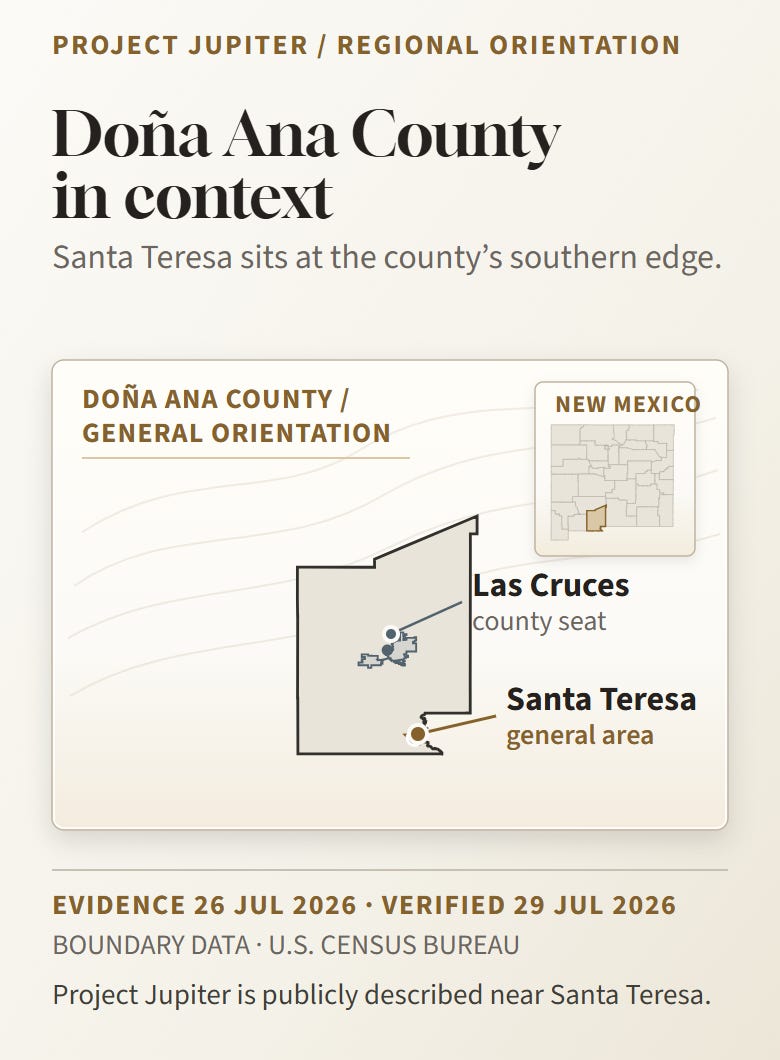
Boundary data: U.S. Census Bureau, 2024 Cartographic Boundary Files for counties and places. Project-location description: Doña Ana County. Census geography is public-domain U.S. government data.
The bargain that entered the room
Project Jupiter arrived as a solution built to the scale of New Mexico’s ambitions and anxieties. The state wanted a place in the artificial-intelligence buildout. Southern New Mexico wanted investment, infrastructure and durable jobs. The sponsors described a project measured in tens of billions of dollars, hundreds of permanent positions, thousands of construction jobs and a power system that would not burden the existing electric grid.
The County’s September 2025 public explanation made the trade vivid. Project Jupiter would receive access to industrial revenue bonds and economic-development incentives. In return, it would make large payment-in-lieu-of-tax contributions, hire locally, fund infrastructure upgrades, contribute to water and wastewater improvements, create at least 750 permanent full-time jobs and avoid adverse effects on local power and water systems.
There was also urgency. County materials warned that if commissioners rejected the bonds, the project would probably move to another state. On September 19, after hours of alternating public comment, failed efforts by Chaparro to postpone action, a closed session and a final round of votes, the Commission approved the bond ordinance 4–1. Sanchez, Christopher Schaljo-Hernandez, Shannon Reynolds and Gloria Gameros voted yes. Chaparro voted no.
The vote created legal capacity, not a finished project. That distinction is easy to lose because the number attached to the ordinance was designed to overwhelm ordinary scale: up to $165 billion.
Here is the simplest accurate way to understand it. The County built an enormous pipe. It did not certify that $165 billion had flowed through it.
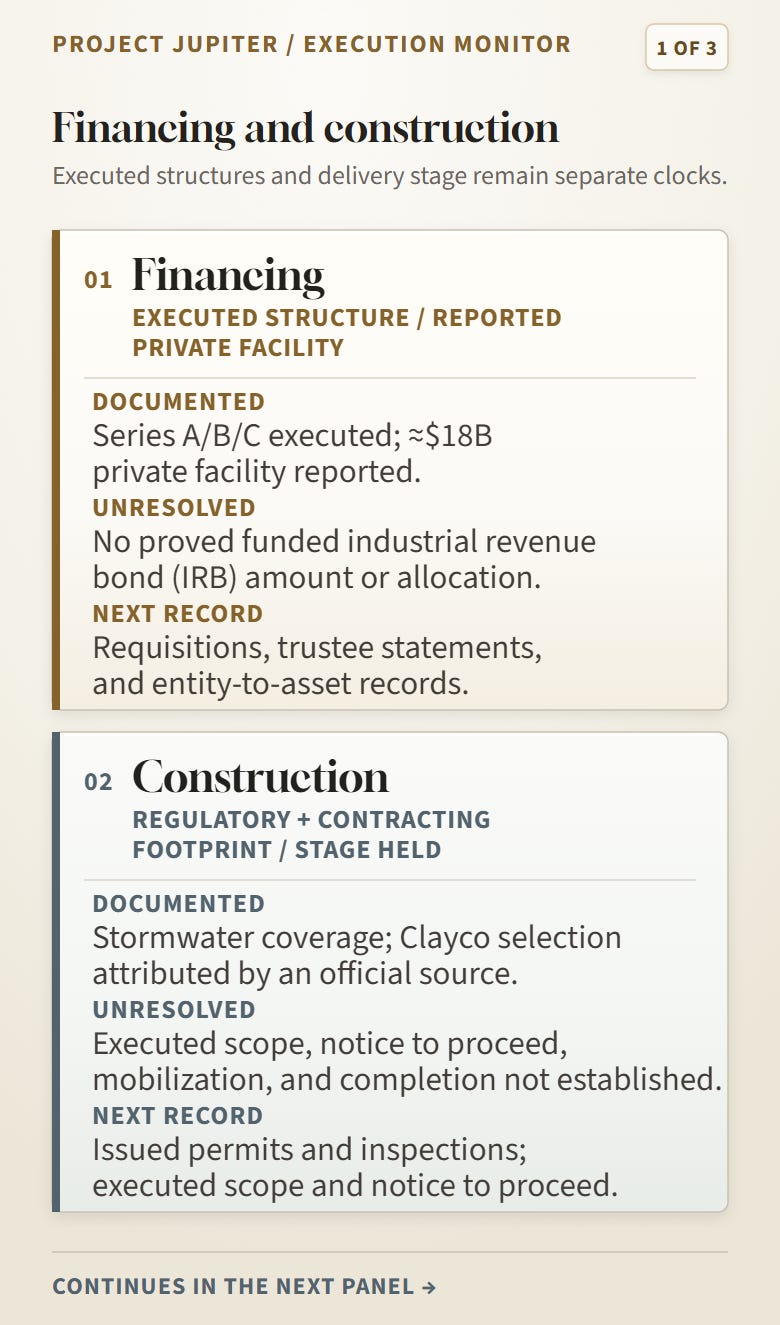
The later closing books divided that maximum among a $15 billion Series A structure, four Series B subseries totaling $25 billion, and four Series C subseries totaling $125 billion. They supplied contracts and procedures through which funds could be requested and advanced. They also left the posted advance panels blank. The public record I reviewed contains no completed requisition, depositary ledger or outstanding-principal statement showing that $165 billion—or any specific fraction of it—moved through those bonds.
That does not mean the project lacked money. It means the headline and the financing evidence answer different questions.
For public diligence, the stack has five stages: authorized; closed; advanced; outstanding and spent; and returned or performed. The County record establishes the first two. It does not establish series-level amounts at the advance, outstanding or expenditure stages. Public-return items—payments in lieu of taxes, gross-receipts-tax sharing, community obligations, water and wastewater commitments, permit-fee arrangements and workforce performance—must be tested on their own formulas, schedules, receipts and outcome evidence rather than added into one headline.
A project with real money—and a misleading headline
The strongest affirmative financing evidence sits outside the County’s $165 billion headline. In November 2025, Reuters, citing Bloomberg, reported that roughly twenty banks were providing an approximately $18 billion project-finance loan for an Oracle-linked New Mexico data-center campus. The reported administrative agents included Sumitomo Mitsui, BNP Paribas, Goldman Sachs and Mitsubishi UFJ, with syndication to additional banks and institutional investors expected.
I assess with high confidence that the combined record shows substantial and layered financial commitment. A consortium of major banks does not assemble an $18 billion facility for a civic brochure. The County also executed nine bond-purchase agreements involving project companies, purchasers and institutional depositaries. A U.S. Securities and Exchange Commission (SEC) subsidiary exhibit listed the Red Chiles entities and related special-purpose companies among subsidiaries of Blue Owl Real Estate Net Lease Trust as of December 31, 2025.
The Series 2025B documents separate Red Chiles A through D as the four project companies and lessees, and pair them with Red Chiles Sub A through D as purchasers for the corresponding subseries. In this setting, a special-purpose entity is a company organized to hold a defined asset, contract, financing obligation or risk rather than the public-facing project as a whole. The structure can isolate liabilities and match financing to particular facilities, but it also means accountability runs through the specific entity and instrument. Neither the County papers nor the SEC list, by itself, establishes the complete ownership chain, current day-to-day control or allocation of every asset.
But the layers must not be collapsed. The reported private loan is not proof of an $18 billion advance through the County bonds. The $165 billion ceiling is not proof of realized investment. And neither number, by itself, tells a stakeholder which entity owns which asset, which phase has been funded, or what conditions remain before additional money can move.
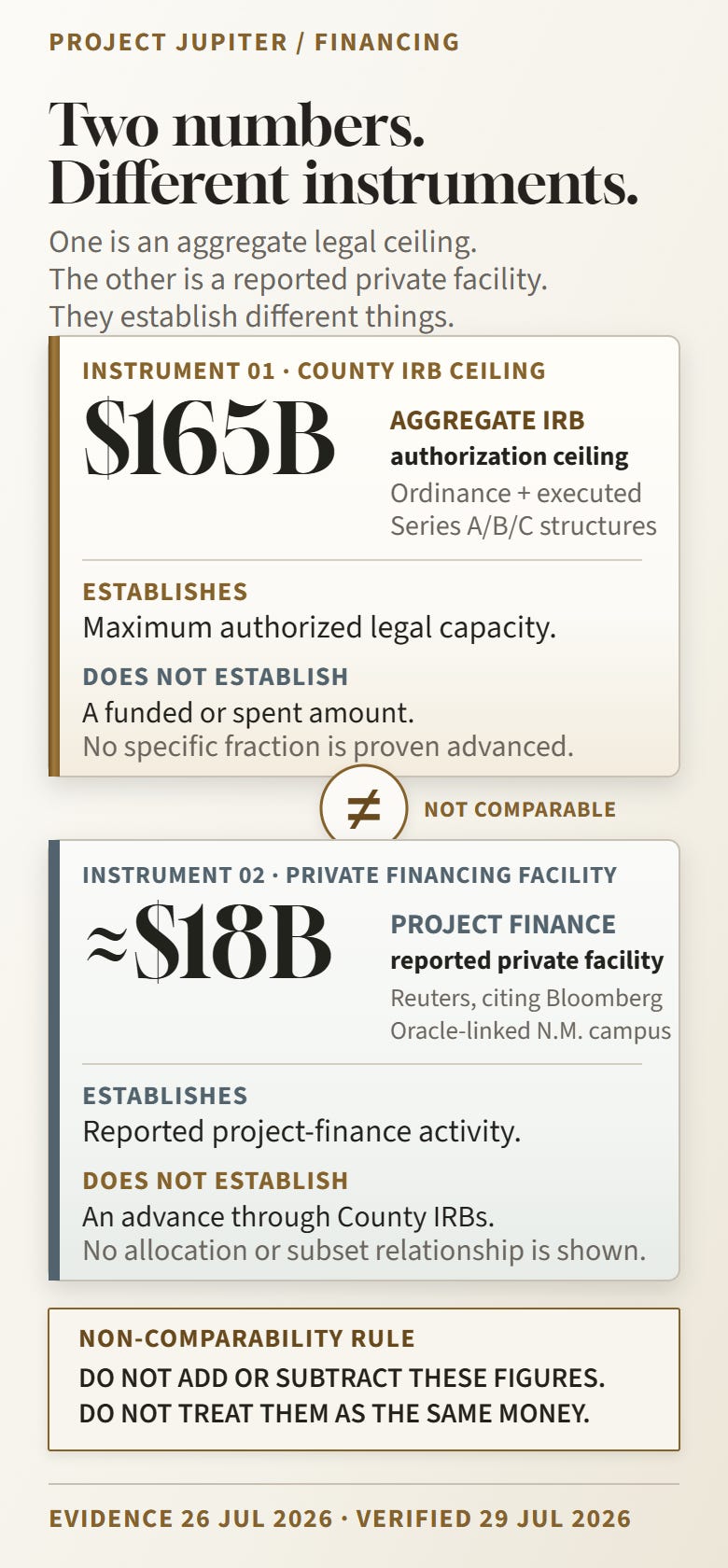
Sources: Doña Ana County Ordinance 367-2025 and executed Series A/B/C instruments; Reuters, citing Bloomberg, November 7, 2025.
The more useful assessment is affirmative: financing activity is real. The uncertainty lies in allocation.
That distinction matters because “Project Jupiter” is a public name, not a legal person. The County documents distribute functions among Yucca Growth Infrastructure, Red Chiles A through D, Green Chile Ventures, Oracle America, purchasers, depositaries and other entities. Other records add Blue Owl-related companies, Bloom Energy, STACK, BorderPlex, Clayco and Acoma. This may be normal project-finance engineering: isolate assets, match liabilities to functions and give different capital providers claims against different parts of the development.
It also changes accountability. A promise attributed to “the project” is not decision-grade until the responsible legal entity, contract and remedy are identified. If a power permit fails, a reporting covenant is missed or an infrastructure route disappears, the exposed party depends on which agreement governs that function. The entity map is therefore not corporate trivia. It is the map of who can perform, who can enforce, and who can lose.
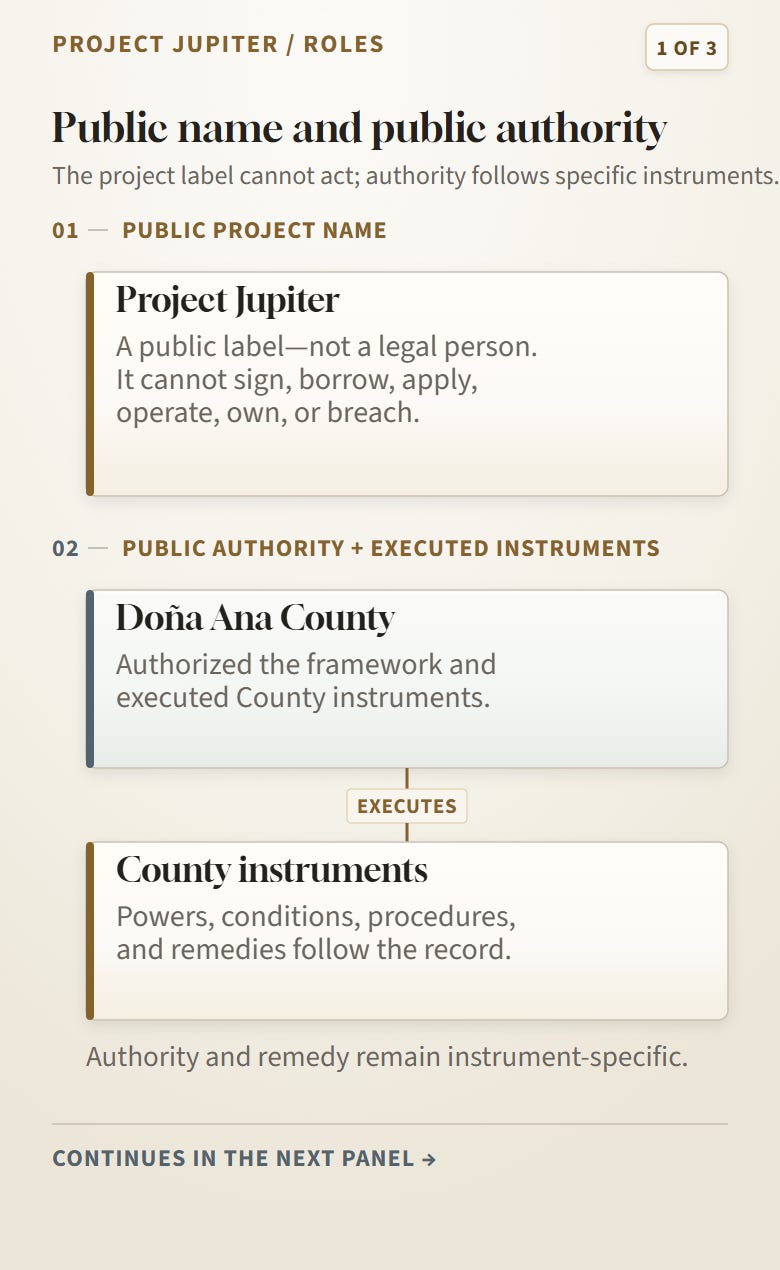
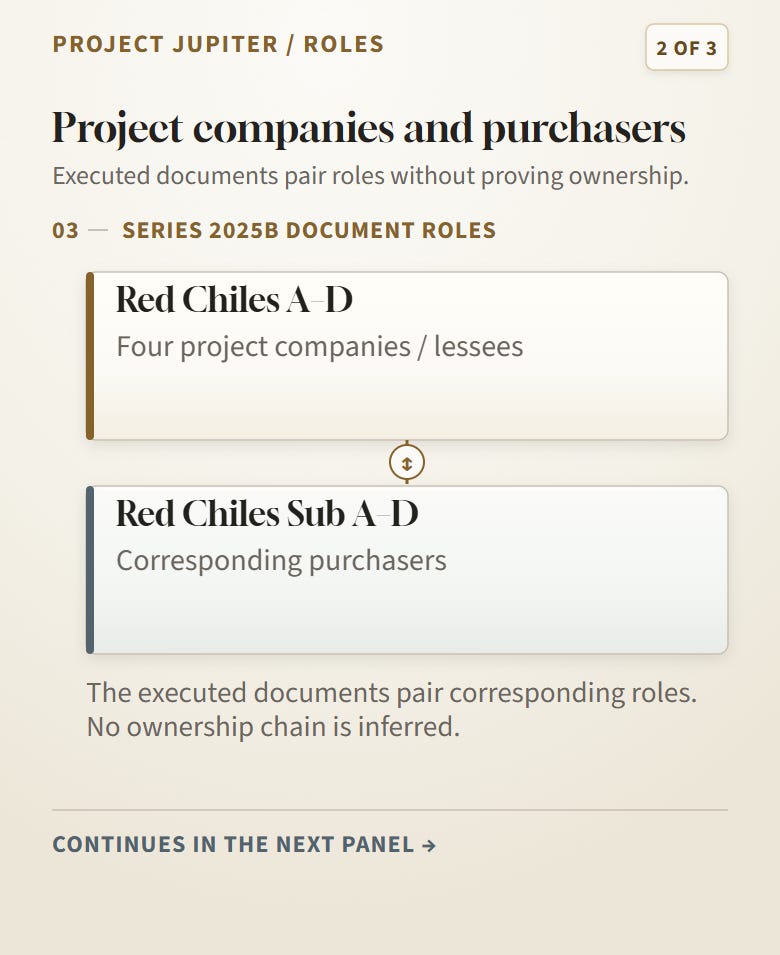
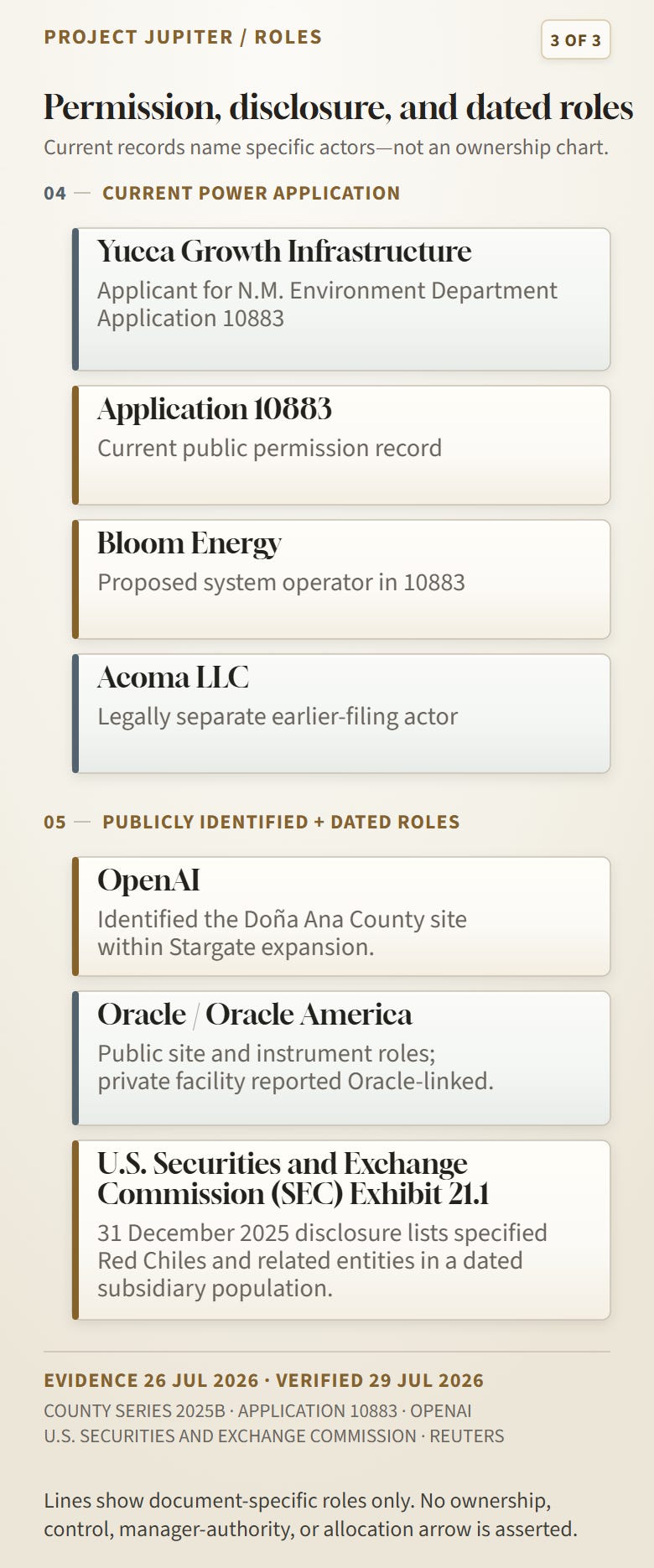
Sources: executed Doña Ana County Series 2025B instruments; New Mexico Environment Department (NMED) Application 10883; OpenAI’s Stargate site announcement; U.S. Securities and Exchange Commission (SEC) Exhibit 21.1; Reuters reporting. Roles are document- and date-specific.
The project changed after the vote
The County did not approve a static object. It approved a framework around a project that continued to change.
Some changes were written into later agreements. The early County framework described at least $50 billion of investment within the first five years of the financing term. The definitive participation agreement used a different formulation for the parties it covered: approximately $50 billion by October 23, 2035. “At least” became “approximately.” Five years became a fixed date roughly a decade away.
The employment language also moved. The September memorandum contemplated 750 full-time-equivalent jobs and 50 part-time positions within three years after operations began. The later agreement set a target of approximately 750 employees or full-time equivalents by December 31, 2031, and allowed qualifying third-party contractors to count within its definition. The sponsor’s current site goes further in public-facing terms, describing 4,000 construction jobs and 1,500 ongoing “project-supported” jobs.
Those figures are not necessarily inconsistent. They are not interchangeable either. Construction workers, operating employees, contractors and “project-supported” jobs measure different things. A larger number can be true while representing a weaker or broader category.
I assess with high confidence that the public employment story expanded faster than the County’s verification system. The decision consequence is straightforward: no serious reviewer should accept a single jobs headline. The County should report each category against the definition, clock and documentary obligation that governs it.
The power system changed more dramatically.
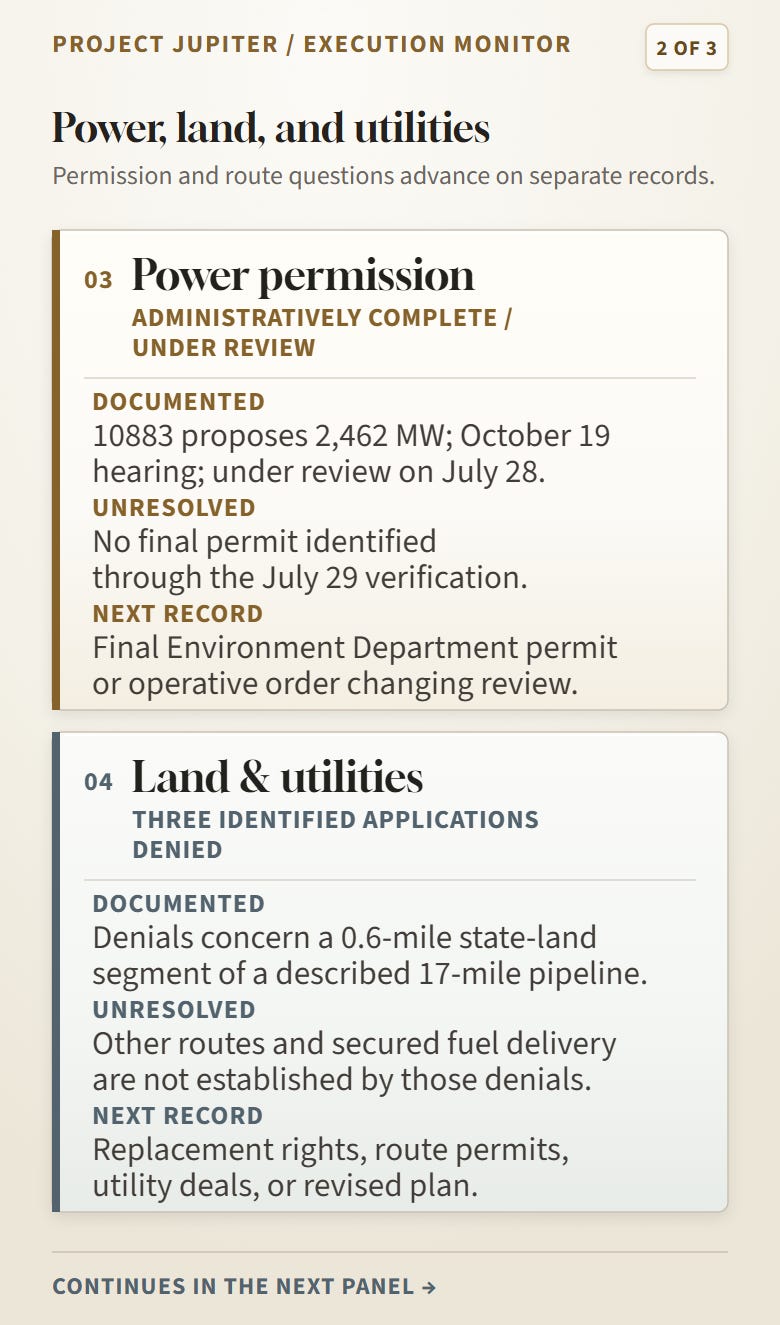
Earlier applications proposed turbine-backed microgrids through Acoma LLC. In April 2026, Yucca Growth Infrastructure (YGI) filed a new application for a single 2,462-megawatt natural-gas-fueled solid-oxide fuel-cell system operated by Bloom Energy and represented that the affiliate’s earlier applications were being withdrawn. The shift changed the applicant, equipment, configuration, emissions modeling, water questions and regulatory path.
It may ultimately improve some impacts. It does not erase the governance problem. The system presented to regulators in April was not simply the same machine with a different label.
NMED deemed the new application administratively complete on May 27. That was a process milestone, not permission to build or operate the power plant. In NMED’s July 28 status update, Permit 10883 remained under review and the page continued to display an August 25 review field. A July 16 scheduling order set a public hearing beginning October 19. YGI had sought faster action and asserted a November 23 deadline. The docket added appearances and discovery-related party filings on July 27–28; none was a final permit or an order changing the hearing date. No final air permit was identified through the July 29 verification.
I assess with high confidence that the power solution remains a critical execution gate. A more tentative—but consequential—inference is that the emergency request reflects schedule pressure between construction plans and the environmental-review clock. That inference has alternatives: the filing may simply preserve legal rights or seek ordinary docket management. A final permit, a revised construction schedule or an executed power-supply milestone would materially raise or lower confidence.
Water reveals a related problem: the same word can carry different bargains. Early County messaging emphasized closed-loop cooling and represented that average operational water demand would be modest. Later controversy focused on whether larger quantities discussed elsewhere included construction water, non-potable water, power-generation demand, emergency capacity or total campus demand. The definitive participation language applied its numerical cap to potable operational water. Those modifiers matter. They narrow what the promise measures.
That does not prove the County was deceived. Different estimates can describe different phases and water classes. It does establish why a headline comparison cannot resolve the issue. A 20,000-gallon average for potable operational use does not answer total construction use, non-potable demand, peak emergency needs, off-site infrastructure demand or the water implications of a redesigned power system.
I assess with high confidence that the public water debate has mixed unlike categories. The proper remedy is not another global estimate. It is a phase-by-phase water budget stating source, quality, purpose, maximum draw, average draw, infrastructure owner, agreement and monitoring method. Until that exists, confident declarations that the water issue has either vanished or exploded beyond the bargain exceed the evidence.
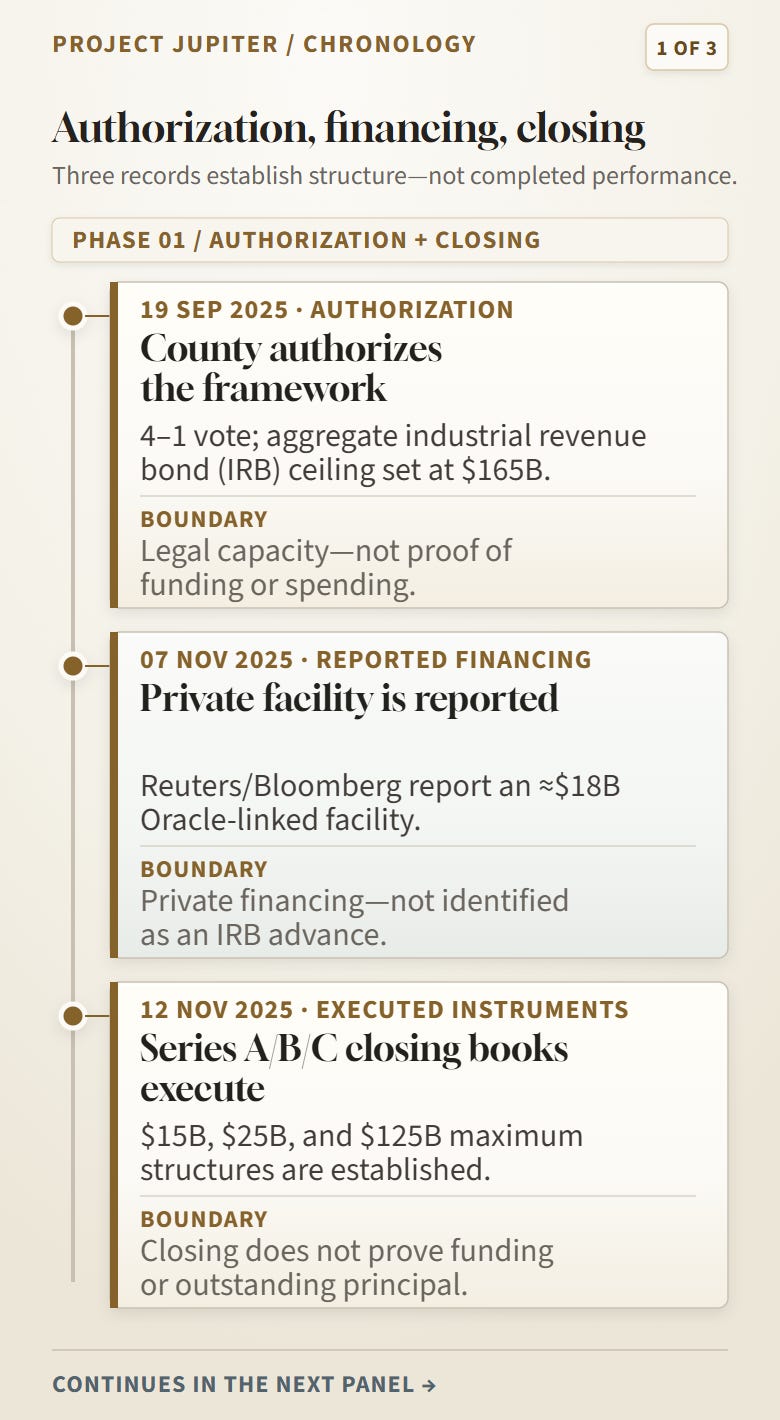
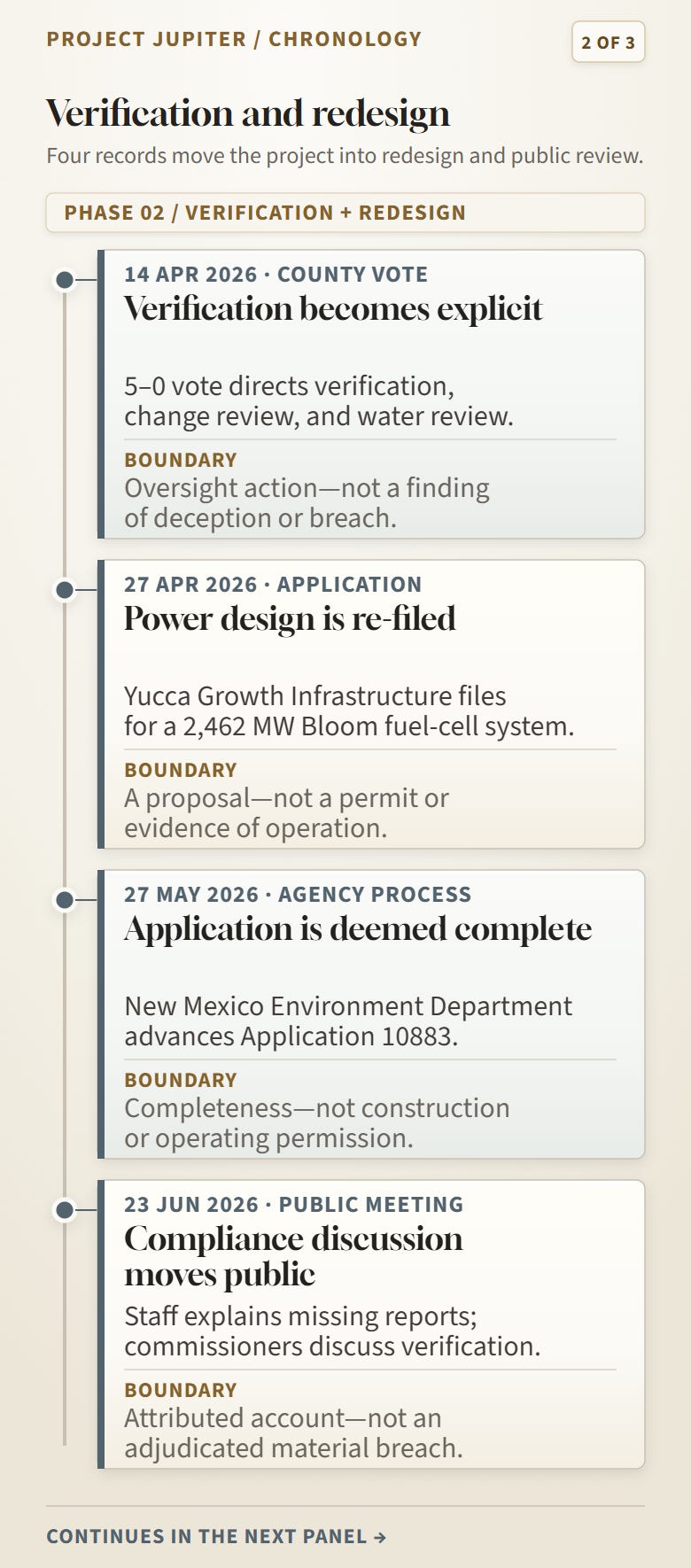
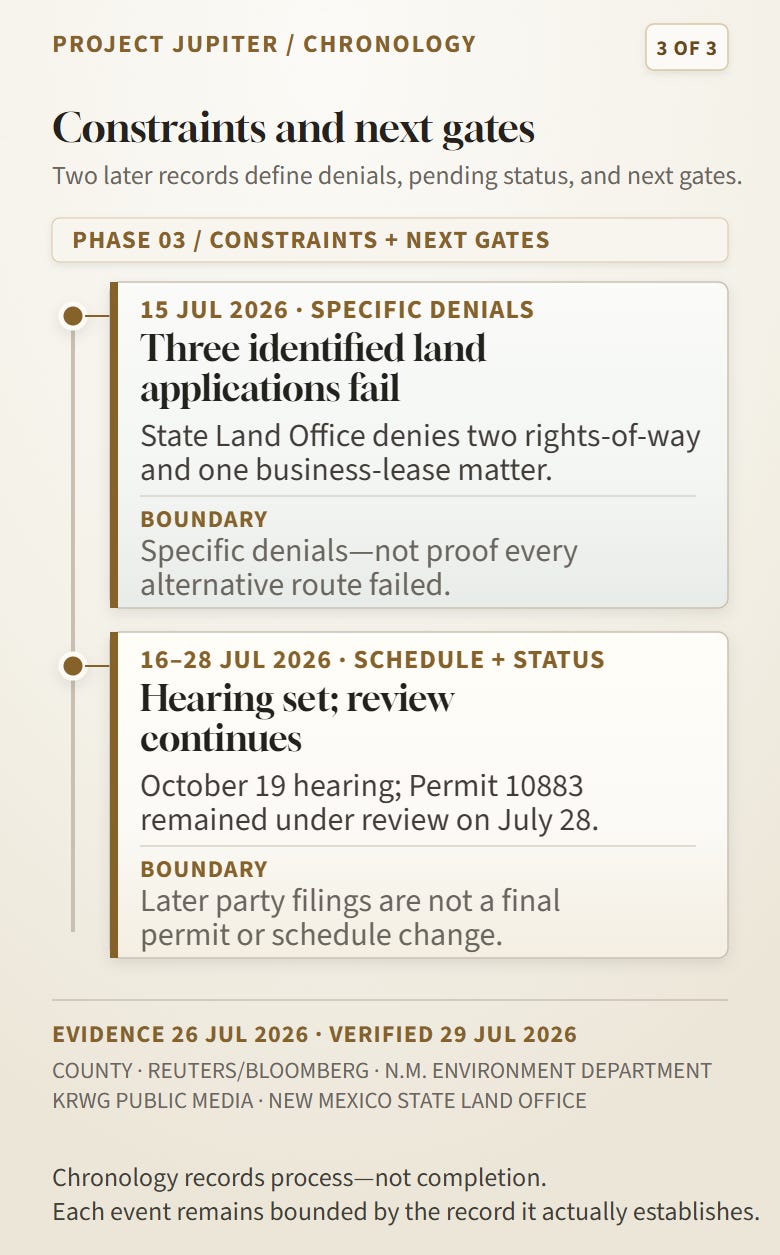
Sources: Doña Ana County instruments and releases; Reuters, citing Bloomberg; New Mexico Environment Department (NMED) Application 10883, completeness letter, and scheduling order; KRWG Public Media; New Mexico State Land Office.
Paper reaches the ground
The project’s defenders and critics often argue over construction as if the only choices were “nothing has started” and “the campus is being built.” The records support a more useful stage assessment.
U.S. Environmental Protection Agency (EPA) stormwater records for National Pollutant Discharge Elimination System (NPDES) ID NMR1007GT show active construction coverage for “Project Miner,” identify Clayco as permit operator and describe up to 630 acres of proposed disturbance. Official County language in April called the campus “currently under construction.” Sponsor materials have reported a construction team and hours worked. An official City of Sunland Park page attributes to Project Jupiter the selection of Clayco as general contractor and states that the matter is not a city procurement. These are not all the same kind of proof, but together they support a high-confidence assessment that the project has moved beyond announcement and legal closing into a construction-facing regulatory and contracting footprint.
What they do not establish is the highest stage reached by every component. A stormwater permit can precede earth disturbance. An attributed contractor selection is not an executed contract or a notice to proceed (NTP). The reviewed public record does not establish the exact contracting entity, scope, price, mobilization, approved vertical-construction package or physical completion. County building permits, inspection records and dated site evidence would show more.
On the ten-rung ladder from announcement to contractual performance, the overall development has plainly passed authorization and legal closing. The available evidence strongly indicates mobilization or sitework for at least part of the campus. It does not yet establish commissioned data halls, an operating microgrid or performance against long-term job and public-benefit promises.
That is not a semantic compromise. It is the difference between momentum and completion.
Infrastructure rights remain similarly specific. On July 15, the New Mexico State Land Office (NMSLO) announced that it had denied reconsideration of two rights-of-way applications and one business-lease application involving a 0.6-mile state-land portion of a described 17-mile natural-gas pipeline. Those are real adverse decisions for the identified applications and segment. They do not prove that every possible route is barred, that a lawful alternative exists or that fuel delivery has been secured. They do prove that at least one planned pathway cannot simply be assumed.
I assess with moderate confidence that Project Jupiter’s central challenge is now coordination: capital, construction, power permission, land rights, water arrangements and public-benefit reporting are advancing on different clocks. Megaprojects often tolerate that mismatch—until one critical path becomes the schedule.
The conclusion is stronger than “more information is needed.” The project has crossed the point at which abstract feasibility is the principal question. Its risk has migrated. Before closing, the County faced selection risk: whether to choose this bargain. After closing and mobilization, stakeholders face interface risk: whether separately advancing systems meet at the right moment. A lender can be ready while an air permit is not. A contractor can mobilize while a land route is denied. A County can own formal remedies while lacking the reports needed to know whether to invoke them.
That migration is one of the most important facts in the record, and one of the least visible in ordinary coverage. It means yesterday’s favorable evidence—an ordinance, a closing, a contractor selection—does not answer today’s decision. The relevant evidence is whatever controls the next irreversible commitment.
Oversight catches up
The County’s institutional shift became visible before the June meeting.
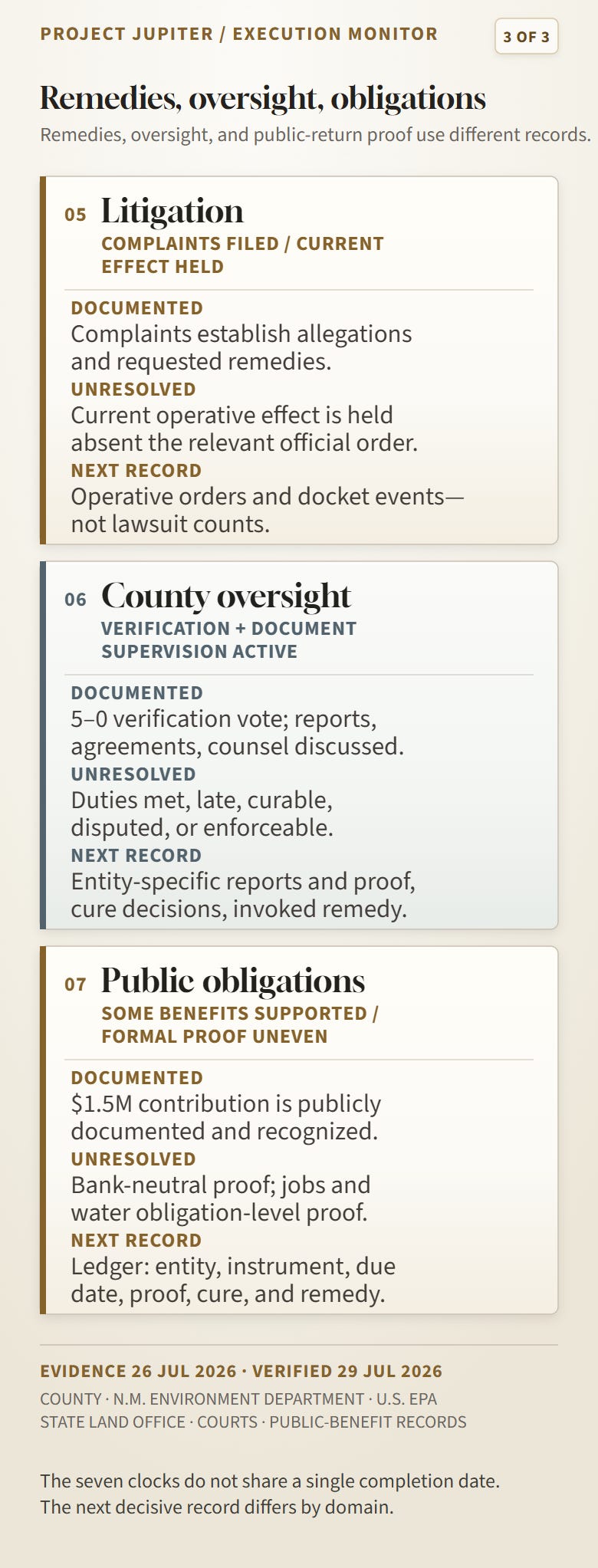
On April 14, the Commission voted unanimously to direct the County Manager and two commissioners to verify public statements, determine whether project details had changed, examine water impacts and bring the information back into public view. The County’s own release said the Board wanted “transparency, compliance to agreements and protecting community resources.” County Attorney Cari Neill said publicly that officials did not yet have enough information to determine whether reported statements were consistent with the bond agreements.
The vote mattered because it was not the old 4–1 coalition replaying itself. Chaparro, the consistent no vote who had tried to slow the September process, joined the commissioners who had authorized the framework. The Board did not find deception or breach. It agreed that verification had become necessary.
By June, the issue was no longer only whether plans had changed. Staff described two quarterly job reports as unsubmitted, while supplying explanations for each. Staff had requested environmental agreements and set another deadline. Chaparro demanded answers from STACK, Bloom Energy, OpenAI and Oracle in a public meeting. Sanchez discussed counsel and the County’s regulatory responsibility.
This progression supports a high-confidence institutional assessment: the County’s posture moved from reliance on sponsor representations toward document-based supervision. It also reveals the original system’s weakness. A local government can authorize a framework in a single vote. It must monitor a distributed megaproject obligation by obligation, quarter after quarter, across agencies it does not control.
The $1.5 million Boys & Girls Club contribution shows why confidence grading matters. Public evidence includes the County’s payment representation, a ceremonial check presentation, Board recognition of partial fulfillment, and recipient statements acknowledging the donation and intended use. I assess with high confidence that the contribution was presented, accepted publicly and treated by both County and recipient as delivered. However, I do not have the independent remittance or cleared-funds record that would support an audit-grade accounting conclusion.
Those statements are not contradictory. For the public, the benefit is strongly supported. For an auditor or lender testing formal compliance, the file should contain bank-neutral proof.
The same stage discipline applies to the wider public-support record. The July 14 final-budget packet lists $4,082,624.21 and $2,562.99—$4,085,187.20 in total—for the relevant fund. That is a budget entry, not proof of receipt, transfer, company payment, expenditure, infrastructure completion or contractual performance. The Community Benefits Agreement separately schedules $6.9 million in community initiatives and $4.5 million in County-project payments associated with the permit-fee arrangement. Those are scheduled components, not independent proof that $11.4 million has been performed.
I do not publish a composite subsidy, net-benefit, environmental-social-governance or probability score. The eligible property base, mill rates, depreciation, timing, actual bond advances, gross-receipts-tax collections, public costs and realized returns remain incomplete. Adding unlike stages and opposite cash directions would produce precision without truth.
The struggle to define consent
Project Jupiter’s public conflict is no longer confined to water, emissions and taxes. It is also a fight over who gets to describe the project—and whose voice appears to support it.
The State Ethics Commission sued Elevate New Mexico over an allegedly undisclosed lobbying campaign connected to Project Jupiter. Reporting has described paid advertising, mail, influencer recruitment and canvassing. Separately, residents and public officials alleged that supportive comments appeared under their names without permission. On July 9, the New Mexico Department of Justice announced that it had opened an investigation into allegations concerning public comments submitted on YGI’s permit application. Oracle disputed wrongdoing and said it was cooperating.
These are allegations and official investigative steps, not adjudicated findings. The record available to me does not establish who created any unauthorized submission or whether a project company directed unlawful conduct.
But it would be a mistake to quarantine the entire human record. Official meeting video contains attributable oral testimony. Organizational letters with verified provenance provide genuine institutional positions. Other submissions can be graded according to identity and context. Template or campaign-associated comments may reveal message mechanics even when they cannot prove individual belief. Specifically disputed comments should never be attributed to the named person without independent confirmation.
The result is not a poll. It is a map of the legitimacy contest.
I assess with moderate confidence that this contest has become an execution risk. The reason is not that bad publicity automatically stops construction. Trust now intersects with regulatory hearings, County oversight, lobbying disclosure and litigation over the approval process. A project can win every engineering argument and still lose institutional room to maneuver if officials no longer trust the representations reaching them.
There is another implication. Public comments traditionally serve two functions at once: they help agencies identify issues, and they provide officials with a rough picture of public concern. When provenance becomes disputed, those functions separate. A questionable comment may be useless as evidence of the named person’s view yet still reveal a campaign theme, a process weakness or an issue that regulators must examine independently. The answer is neither to count everything nor discard everything. It is to grade the source and use it only for what its provenance can support.
That is the difference between public relations and intelligence. Public relations aggregates voices toward a desired impression. Intelligence asks what each voice can establish, what it cannot, and what decision changes if it is authentic.
Four legal fronts, one process vulnerability
Project Jupiter has drawn multiple legal challenges, but “the project is tied up in court” is too crude to be useful.
The reviewed complaints establish filings, allegations and requested remedies. They do not, by themselves, establish adjudicated facts or the current effect of any case. One challenges administrative approval; another attacks the process surrounding the September vote under the Open Meetings Act; a narrower Inspection of Public Records Act dispute concerns 29 emails. The precise posture and effect of each matter must remain separate.
No current official docket-wide authority was acquired through no-credential public access for this release. Any statement that an ordinance, agreement, payment or project right is void, stayed, enjoined, upheld or finally adjudicated therefore remains held absent the relevant operative order. I nevertheless assess with high confidence that litigation risk is material because several independent challengers attack the completeness, transparency and legality of the process that produced the approvals—and the closing documents themselves allocate the possibility that the bond ordinance could be invalidated.
That last point changes the business analysis. Litigation is not merely outside noise surrounding a finished transaction. It is a contingency the transaction documents anticipated.
A lower-confidence but decision-relevant inference follows. The cases may matter most through delay, disclosure and bargaining leverage rather than a single project-killing judgment. That outcome is not inevitable. A clean administrative record and favorable merits rulings could narrow the risk quickly; an adverse order, discovery revealing a process defect, or a stay in another proceeding could expand it. Stakeholders should track operative orders, not lawsuit counts.
The acquired litigation record refuses the two cleanest stories available to the opposing sides. The complaints do not establish that the project has been stopped, and their existence does not establish that the claims have been resolved or lack consequence. The non-litigation record shows a project moving; the held legal record leaves that movement exposed to consequences that only current operative orders can define.
For executives, that posture should not trigger panic or complacency. It calls for instrument-specific diligence. Which expenditure becomes unrecoverable if an approval is later vacated? Which contract has a termination, suspension or change-in-law clause? Which advance sits behind a legal-validity condition? Which schedule assumption depends on an uncontested County action? The public docket cannot answer every private-contract question, but it tells counterparties which questions have become material.
What Project Jupiter has become
Project Jupiter is often described through binaries: boom or boondoggle, construction site or paper project, clean infrastructure or environmental threat, $165 billion investment or accounting illusion. The documents support none of those simplifications.
The project is real. It has powerful counterparties, significant reported private financing, executed County instruments and evidence of physical momentum. Claims that it is merely a stack of press releases are no longer credible.
The bargain is unsettled. The later agreements changed important clocks and definitions. The public jobs story broadened. The power design was replaced. Environmental permission remains live. Identified state-land applications failed. Reporting and environmental documents were still being chased months after closing. Claims that approval settled the project’s meaning are equally untenable.
The County is not powerless, but its leverage is fragmented. It can enforce the instruments it signed, administer local permits, demand reporting and consult counsel. State and federal agencies control other permissions. Private lenders and counterparties control capital and contractual milestones. Courts control the validity of challenged governmental action. No single institution possesses the whole project.
That is why “contested execution” is the right description. The contest is not simply political opposition. It is a race among several clocks: finance, construction, permission, litigation and public accountability.
For County and state officials, the immediate decision is to turn public promises into an obligation-level dashboard: responsible entity, governing instrument, due date, proof received, cure right and remedy. For lenders and investors, the issue is not the $165 billion headline but whether the financed entity has the permits, land rights, counterparties and litigation protections needed for its phase. Contractors need executed scope, notice to proceed and permit clarity. Community institutions need benefits stated in measurable categories. Litigators need the actual administrative and closing records, not public rhetoric.
The most important next facts are identifiable. A final air-permit decision. Issued building and grading permits and inspection records. Completed bond-advance and trustee statements. The executed contractor and power-supply instruments. The County’s overdue or completed compliance reports. Resolved land and utility pathways. Operative court orders. Entity-specific evidence showing which capital funds which asset.
Sources: the article’s executed County instruments, New Mexico Environment Department docket, U.S. Environmental Protection Agency permit record, New Mexico State Land Office decisions, County oversight records, public-benefit records, and identified litigation materials. Evidence current through July 26, 2026; last verified July 29, 2026.
Each would move the assessment. None can be replaced by another press release.
Five reconciliations change the story now.
First, the $165 billion number is a legal ceiling, while the reported $18 billion bank facility is evidence of actual financing activity. Separating them makes the project look less sensational and more real.
Second, the transition from the original power concept to the fuel-cell application is not a footnote. It changes the project’s permission path and helps explain why County verification followed approval.
Third, the County’s unanimous April vote and June compliance discussion are not merely political aftershocks. They mark an institutional transition from authorization to supervision.
Fourth, the lawsuits have not produced a publicly established project-wide stop, but they attack the approval process at the exact point the closing documents recognize invalidation risk.
Fifth, the legitimacy controversy is not a sideshow about rude politics. It degrades the information channel on which regulators and elected officials depend.
Together, these findings displace the familiar question—whether Project Jupiter is good or bad—with a harder and more useful one: whether the system surrounding it can still distinguish promise, permission, performance and proof.
Project Jupiter is a local story with national stakes. Across the United States, AI infrastructure is arriving in jurisdictions whose approval systems were built for projects that moved more slowly, used fewer legal entities and asked less of power, water and public trust at once. A megaproject can change configuration between the sales pitch and the permit application. Capital can arrive through structures that obscure ordinary measures of “investment.” Construction can begin on one component while permission remains unresolved for another. Local officials can discover that voting yes was the simplest part of governing what they approved.
On June 23, Manuel Sanchez put that discovery into plain language. The County had become the regulator of a bargain it was still trying to see whole.
Project Jupiter did not outrun government because no one was watching. It outran the assumption that one vote, one number and one project name could contain it.
The transaction closed. The contest over what was actually promised—and who must prove it—had only begun.
Sources and updates. Inline links identify the principal records supporting this analysis. Evidence current through July 26, 2026; last verified July 29, 2026.
Method and limitations. This analysis uses publicly available instruments, agency records, filings, official statements and clearly attributed secondary context. It separates established fact, instrument term, attributed statement, allegation, inference, scheduled event, contradiction, held material and unknown. It does not publish exact coordinates, granular routes, parcels, signatures, personal contacts, private information or security-sensitive infrastructure detail. It does not infer entity identity from similar names, treat pleadings as adjudicated facts, or calculate aggregate subsidy, net benefit, probability, influence, ESG or composite risk without the missing inputs and specialist review.
This material is for general informational purposes only and is not legal, engineering, tax, investment, environmental, water, utility, project-finance or other professional advice.